
This article first appeared in Open Access Government April 2026.
As Europe solidifies its climate policies for 2040 and 2050, the Past to Future (P2F) project seeks to validate climate models against a broader spectrum of past climate conditions. Learn why this approach is crucial for informing long-term infrastructure, land use, and financial planning.
Europe’s climate policy has entered a decisive decade. As targets for 2040 and 2050 harden into legislation, governments are consulting climate models to guide choices with multi-decade consequences. The question now is whether those models are robust enough for high-stakes law, infrastructure, and financial oversight.
Past to Future (P2F) strengthens that foundation by drawing on one of the most underused strategic resources: the deep history of Earth’s climate. It expands today’s evidence base beyond the 150-year instrumental records to real, warmer-than-present climates the Earth has already experienced.
Why past climate belongs in today’s policy
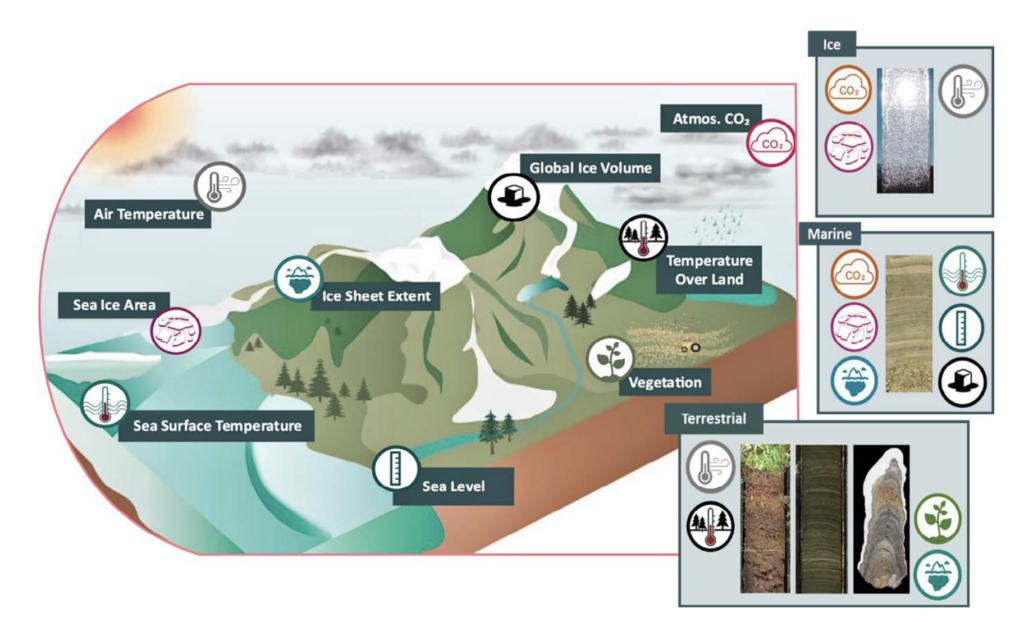
Weather stations, satellites, and ocean measurements provide an exceptionally detailed picture of how the climate has changed over the last 150-170 years, but the policy horizon runs far beyond mid-century. Many conditions Europe must prepare for have no analogue in the instrumental record. Earth’s natural archives – ice cores, ocean sediments, tree rings – capture climate states across hundreds of thousands to millions of years, including warm periods relevant to the late 21st century.
From a policy perspective, this longer view matters when planning for infrastructure, land use, and financial frameworks that must endure beyond 2050.
What P2F does differently
P2F’s premise is simple: if climate models guide mitigation, adaptation, and investment, they should be tested against this wider spectrum of past climate conditions, not only the recent record. When simulations reproduce known climates from Earth’s history, confidence in similar future projections increases; when they do not, discrepancies indicate processes that need refinement before outputs can be used with confidence to design regulation or allocate capital.
Instead of explaining models, P2F focuses on how to validate them against independent paleoclimate evidence.
By refining climate models using real data from past warm periods the Earth has already experienced, we strengthen confidence in the projections that guide long term policy.
– Prof. dr. Anna S. von der Heydt, Project Coordinator
Reducing uncertainty and improving early warning
P2F analyses past warm periods and abrupt transitions – rapid reorganisations of ocean circulation, persistent monsoon shifts, multi-decadal droughts – to understand how risks unfold. Researchers look for subtle signals that preceded major shifts, such as changing variability or threshold-like behaviour in ice and ocean indicators.
The aim is not to achieve date-specific prediction. It is to clarify which patterns deserve priority in real-time monitoring and dashboards used by national authorities and European agencies, helping to focus attention on the most informative signals, rather than an unwieldy list of metrics.
Building a shared backbone of past climate data
At present, ice, sediment, coral, and tree ring records are dispersed across formats with inconsistent metadata. P2F contributes to a more coherent, open data backbone by helping to harmonise formats and documentation, curate datasets for model evaluation, and make these resources discoverable and usable via open science infrastructures. The project’s data work supports reproducibility for assessments and advisory bodies, as well as convenience for the wider research community.
A shared, open paleoclimate data spine lets assessments integrate past-climate constraints with transparency and reproducibility.
– Prof. dr. Lucas Lourens, Project Coordinator
Connecting global history to local choices
Policy is ultimately implemented in specific places: a coastal town deciding where to build sea defences, a river basin authority managing water allocation, a region planning nature restoration or climate-resilient infrastructure. P2F combines climate reconstructions with ecological and archaeological evidence to explore how water availability, vegetation zones, and biodiversity shifted regionally under different conditions, and how societies adapted land use and infrastructure in response.
These insights offer an empirically grounded framework for asking better questions about regional vulnerability and resilience in spatial planning, agriculture, conservation, and heritage protection.
Supporting climate and environment priorities
The timing of P2F aligns with the evolving European climate governance: a legally binding trajectory to climate neutrality, a 2040 target to reduce net emissions by around 90%, and an adaptation agenda that emphasises risk management and resilience. P2F strengthens the evidence base for these processes by stress-testing projections, refining early warning indicators, and enabling transparent use of past-climate constraints in assessments.
For the UK’s net-zero strategy and adaptation planning, P2F’s methods help clarify key concerns, including plausible ranges for sea-level rise, hydrological extremes, and compounding risks.
International cooperation is folded into policy alignment: P2F’s data, model tests, and indicator work are designed to strengthen the analytical foundations on which international assessments and risk dialogues rest, aligning with broader efforts to make climate governance more transparent, evidence-based, and participatory.
A strategic resource for better informed choices
Over its four-year lifetime, P2F will work with policy communities as results emerge, translating technical findings into practically useful formats. The project anticipates better-tested projections, clearer signals to track in early-warning systems, consistent and documented datasets that promote transparent integration of past-climate constraints, and regionally grounded insights that support adaptation questions without overpromising precision.
P2F embeds deep-time climate evidence into the models and indicators that already guide policy. In this way, it contributes to a more resilient foundation for climate governance, clarifying where confidence is justified, where uncertainty remains, and how long-term choices can be made more robust.