
Researchers can now compare boreal wildfire histories across continents and uncover the climate and vegetation forces behind them using a set of 229 charcoal records. Here, Dr. Ramesh Glückler reveals what millennia of sediment‑preserved charcoal can tell us about today’s intensifying boreal fires.
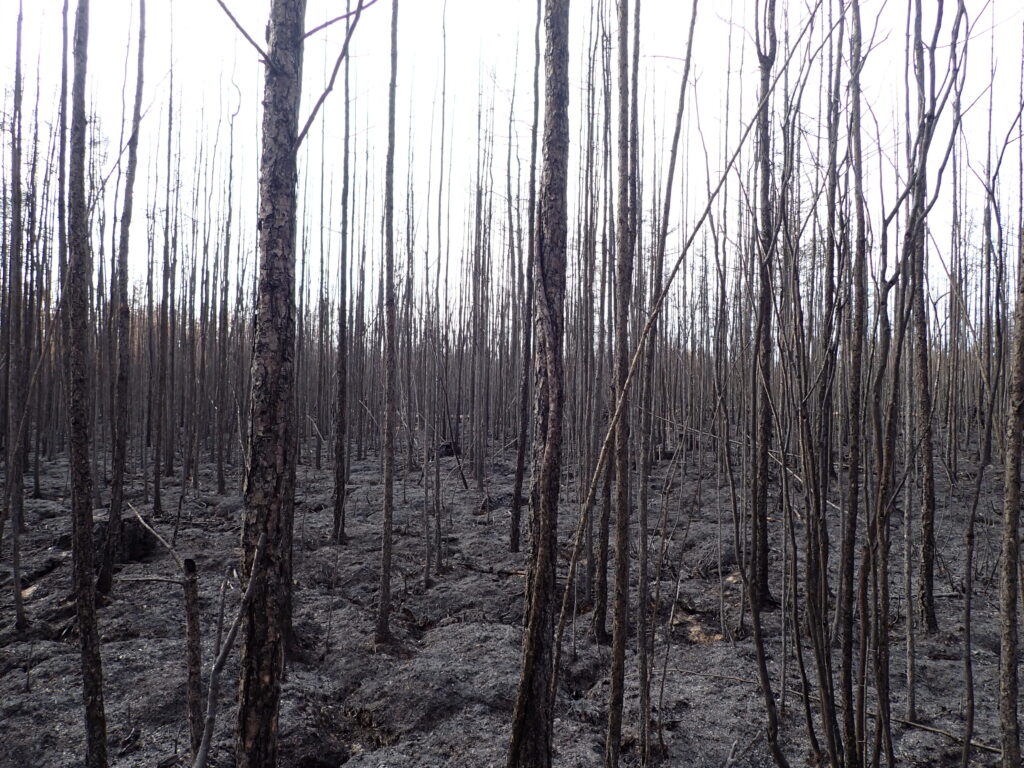
As the largest terrestrial biome on Earth, boreal forests have experienced extreme wildfire seasons in recent years. Among other factors, climate change continues to lengthen the fire season and increase fuel flammability, driving greater wildfire spread and intensity.
Due to the lack of long-term historical baselines, the ecological consequences of this ongoing intensification of fire regimes remain difficult to anticipate. While modern satellite data provides valuable insights into current wildfire activity, its limited temporal coverage, spanning only a few decades, does not provide sufficient information to assess previous fire regime changes and their impacts over a longer timeframe.
Paleoecologists often use accumulated lake or peat sediments as natural archives and analyze charcoal particles extracted from sediment cores as a proxy for past biomass burning. This approach allows researchers to reconstruct fire activity and its relationships to the environment, climate, or society over hundreds and thousands of years.
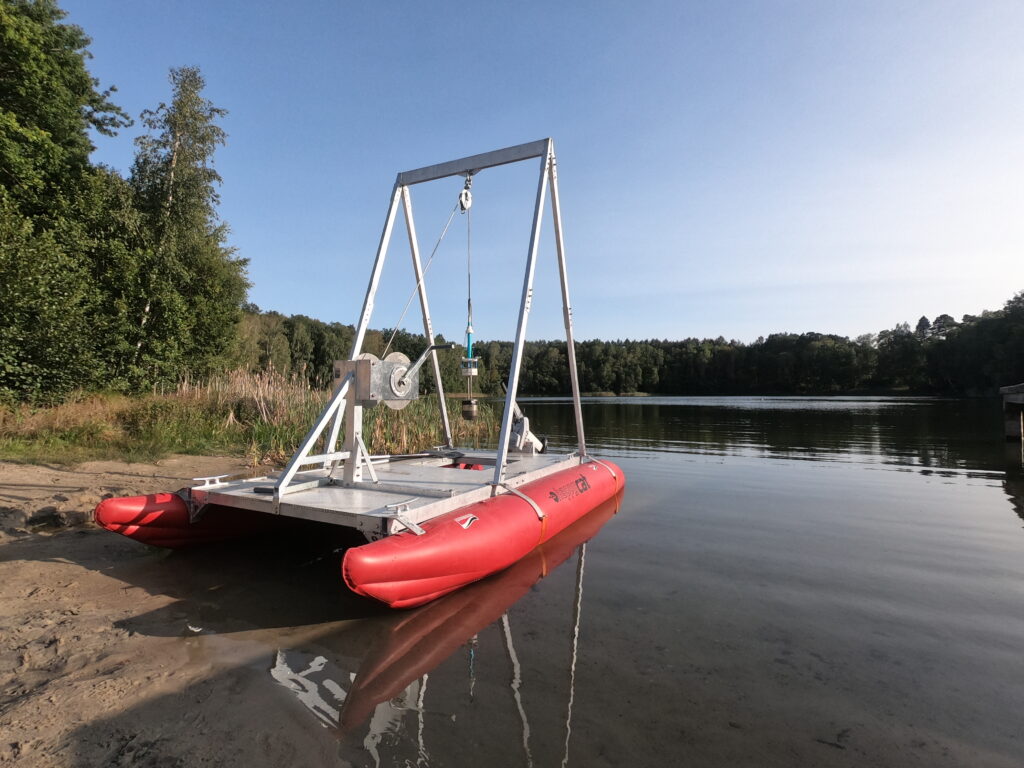
However, this charcoal data is reported in different formats and currently scattered across various databases and private collections, complicating regional and biome-scale data synthesis efforts. To facilitate research on long-term wildfire activity across the world’s boreal zone, we have compiled and harmonized 229 charcoal datasets from multiple sources and made them available within the P2F project.
Using this new data compilation, we were able to conduct an initial comparison of Holocene biomass burning trends across all boreal subregions, including the previously data-scarce Siberia. Results show that over the past ten thousand years, different regions within the boreal zone have experienced contrasting trends in wildfire activity. This is likely related to climatic effects and differences in vegetation composition, since some of the dominant tree species differ markedly in their fire strategies. Using a subset of high-resolution charcoal records from Europe, we also explored the ability to reconstruct the synchronicity of past short-term fire events.
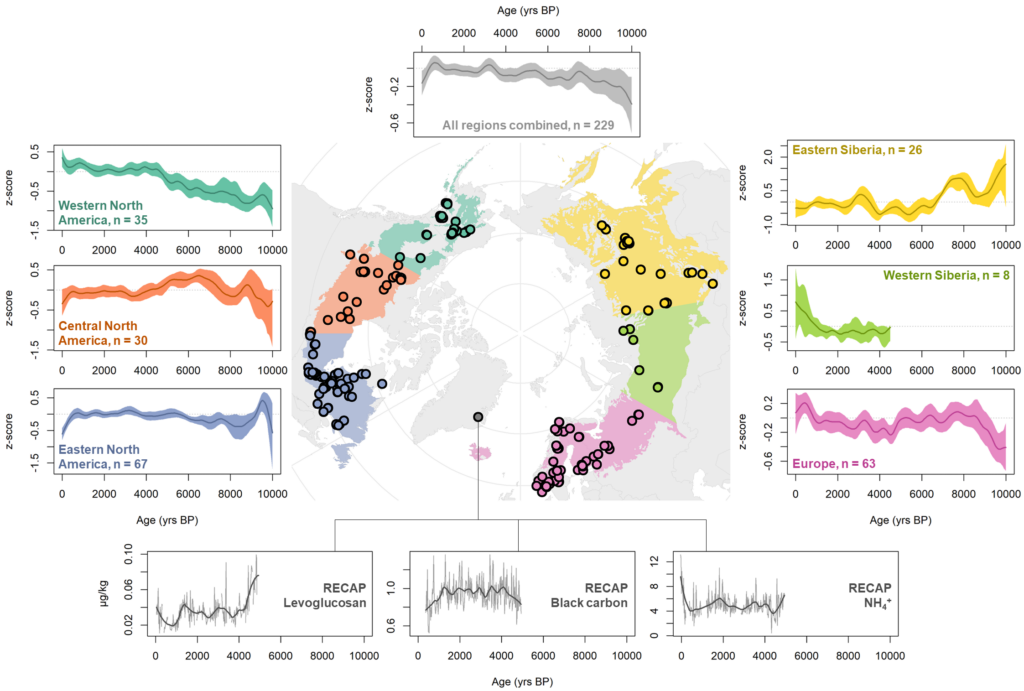
While our approach indicated more synchronized wildfire activity in Europe around 8200 years ago, during a significant period of climatic disturbance, we also identified key conditions necessary for more in-depth analyses of synchronicity. These include a targeted age-dating method and high temporal resolution of the studied sediment cores. The new data compilation enables data-model comparisons to assess how effectively advanced fire-vegetation models can replicate the different reconstructed boreal fire histories, thereby increasing confidence in simulated scenarios and enhancing our ability to predict the impacts of future fire regime changes.
Dr. Ramesh Glückler joins Past to Future as a postdoctoral researcher based at Utrecht University. Read more on this topic in a recent study on past wildfires in eastern Siberia: Glückler, R., Dietze, E., Andreev, A.A. et al. Human activity may have influenced Holocene wildfire dynamics in boreal eastern Siberia. Commun Earth Environ 7, 147 (2026).